|
New
Jersey Aquaculture
Aquaculture
Development
SEPTEMBER 2016: ATTENTION SHELLFISH GROWERS & HATCHERY/NURSERY OPERATORS
The New Commercial Shellfish Aquaculture Permit and the Hatchery/Nursery Permit, through the NJDEP, Bureau of Marine Water Monitoring (BMWM), are effective as of September 19, 2016 (date of rule adoption). These permits require the submission of an application through the BMWM as well as an Operational Plan encompassing on-farm activities and harvest or husbandry procedures. The Aquatic Farmer License Application through the NJDA, Office of Aquaculture Coordination (OAC) has now been revised - for Molluscan Bivalve Shellfish Only - to serve as the required Operational Plan.
To successfully apply for the new permits, please complete and submit to the appropriate office, the following documents:
Both applications have contact information as well as mailing addresses posted on the first page of the applications. It is not required that the Aquatic Farmer License Application be used for the Operational Plan, however, it is highly recommended as the application has been formatted for easier submission of the required information for both permits.
MAPS: One component of the required Operational Plan is the submission of maps containing currently active leases. Maps for the Atlantic Coast may be accessible through the NJDEP, Bureau of Shellfisheries website's September Leasing Policy Document.
If you chose to use the maps in the Leasing Policy Document, you must identify which are your leases (e.g. highlight, circle). If you grow more than one species, or you use more than one method of grow-out (different gear on different leases), you must clearly identify which species and which gear are on each lease. If no species or gear are noted on the maps, it will be assumed that you have one species and one type of gear, as appropriately noted in the Aquatic Farmer License Application.
For more information, please contact:
Amanda Wenczel
Aquacultural Development Specialist
(609) 984-2502
Amanda.Wenczel@ag.state.nj.us
**Any aquaculture operator growing finfish and/or aquatic plants, and NOT growing shellfish should contact the NJDA, Office of Aquaculture Coordination to determine the appropriate application for new licensure or renewal of current activities. A revised application for these species is forthcoming.
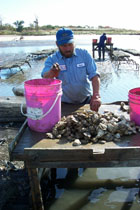 Aquaculture refers to the "farming" of fish, mollusks, crustaceans
and aquatic plants. Farming implies some form of intervention
in the rearing process such as regular stocking, feeding,
protection from predators, etc., to improve production. Aquaculture refers to the "farming" of fish, mollusks, crustaceans
and aquatic plants. Farming implies some form of intervention
in the rearing process such as regular stocking, feeding,
protection from predators, etc., to improve production.
The
primary focus of aquaculture in New Jersey is growth of
bivalve shellfish, primarily hard clams and oysters. The
basic components of shellfish aquaculture include: on-shore
hatcheries where larvae are spawned and raised; leased grounds
within the NJ coastal zone for grow out; maintenance of
the gear and product (shellfish); and harvest once the product
reaches market size (anywhere from 2-5 years dependent upon
species and growing location). Most farmers in NJ do not
have their own hatchery, choosing instead to buy the juvenile
shellfish- called "seed"- from the few hatcheries producing
hard clams and oysters within the state or from nearby states.
NJ cultured shellfish can be found in restaurants locally
or in cities such as New York City and Philadelphia with
an ever increasing presence throughout the region.
Other
aquaculture operations with the state include finfish such
as trout, baitfish, and koi as well as aquatic plants.
The
NJDA Office of Aquaculture Coordination is promoting the
development of the aquaculture within New Jersey by providing
the following: permitting guidance and assistance with the
permitting process; technical assistance to new growers
or those looking into experimental and/or new techniques;
and marketing assistance.
- A
Guide to Developing Aquaculture in NJ
The aquaculture guidebook assists a potential aquaculturist
in completing the Aquatic Farmer License Application by
explaining the application questions and helping to identify
which permits may be required for the proposed operation.
Additionally, the guidebook functions to give an overview
of aquaculture in New Jersey. Items such as climate, species
selection and formulating a business plan, among many
other topics are all contained in the document. "
- Recommended
Management Practices for Aquatic Farms: AMPs and Aquatic
Organism Health Management Plan
Agricultural Management Practices (AMPs) and Aquatic Organism
Health Management Plan This document serves as guidance
to a fish or shellfish farmer, once they have been permitted
to conduct their business by all appropriate agencies
(i.e. NJDEP, NJDOH). The Agricultural Management Practices
(AMPs) are a very general set of guidelines for a farmer.
The main benefit of adopting and implementing AMPs is
receiving Right to Farm protections from the NJDA. Secondarily,
products can also be marketed as being produced under
best management practices (BMPs). The Aquatic Organism
Health Management Plan is designed to assist farmers in
disease prevention and treatment, producing better quality
products, and meeting importation requirements of the
NJDA.
|